
For architects, importers, contractors, and stone distributors, understanding the marble slab production process is one of the best ways to evaluate a supplier’s factory strength. A beautiful finished slab does not happen by accident. It is the result of careful quarry block selection, accurate block cutting, controlled slab polishing, professional surface finishing, strict quality inspection, and secure export packing. Each stage affects the final color consistency, thickness tolerance, surface gloss, edge condition, breakage rate, and installation result.
This guide explains how marble slabs are processed from the quarry to the finished product, using a practical factory perspective. It is written for buyers who want to understand what happens before the stone arrives at a project site. Whether the slabs are used for hotel walls, luxury flooring, countertops, staircases, bathroom panels, or feature walls, the production workflow must be stable and traceable. A strong marble supplier should not only offer attractive stone; it should also demonstrate reliable factory capability, consistent production resources, and a serious approach to quality control.

Why the Marble Slab Production Process Matters
Natural marble is formed by geological pressure and mineral changes over a long period of time, so every block has its own background color, vein direction, crystal structure, and internal features. This natural character is the reason marble is valuable, but it also means production must be managed carefully. A block with beautiful veining may still create problems if it has too many cracks. A polished slab may look elegant, but poor thickness control can cause installation difficulties. Export packing may look simple, but weak crates can lead to expensive breakage during ocean shipping.
For project buyers, the production process is directly connected to risk control. Good factories inspect blocks before cutting, arrange slabs in logical bundles, record slab numbers, monitor polishing quality, protect surfaces, and pack containers according to export requirements. When these steps are done properly, the buyer receives material that is easier to install, easier to match, and easier to approve on site. When the process is weak, even a beautiful marble variety can become a project problem.
Overview of Marble Slab Production Steps
| Production step | Main purpose | Key quality points |
|---|---|---|
| Quarry block selection | Choose suitable raw marble blocks | Color, vein direction, cracks, block size |
| Block cutting | Saw blocks into slabs | Thickness tolerance, cutting speed, slab flatness |
| Slab polishing | Create smooth and glossy surfaces | Gloss level, scratch control, resin treatment |
| Surface finishing | Produce the required texture or finish | Polished, honed, brushed, leathered, antique |
| Quality inspection | Check slabs before packing | Dimensions, color matching, defects, strength |
| Export packing | Protect slabs during transport | Wooden bundles, foam, labels, container loading |
Step 1: Quarry Block Selection
Evaluating Color, Veins, and Block Structure
The marble slab production process begins long before the factory saw starts working. It starts with quarry block selection. At the quarry, workers and inspectors evaluate raw marble blocks according to color tone, vein movement, size, shape, visible cracks, and expected slab yield. A good block should have enough usable volume, attractive natural patterns, and a structure that can survive sawing, polishing, and transport.
For white marble, block selection is especially important because background color differences are easy to see after installation. A project may require a bright white base, a warm ivory tone, or a grey-white background with fine veins. If blocks from very different selections are mixed, the final floor or wall may look uneven. Professional suppliers normally sort blocks by quarry layer, color range, and vein direction before production.
Considering Final Application Before Cutting
Block selection should also consider the final application. Large hotel walls may need bigger slabs with continuous movement. Countertops require enough slab size to reduce visible joints. Flooring projects need consistent color across many square meters. For bookmatched feature walls, the factory must choose blocks that can produce slabs in a sequence with matching veins. This is why early communication between the buyer, designer, and factory is so important.
Step 2: Block Cutting Into Slabs
After block approval, the marble block is transported to the factory for cutting. Factories may use gang saws, multi-wire saws, or bridge saw equipment depending on the block size, material hardness, and required thickness. The goal is to cut the block into slabs with accurate thickness and stable flatness while reducing waste. Common slab thicknesses include 18mm, 20mm, and 30mm, although custom thicknesses may be produced for special projects.
Cutting speed must be controlled. If cutting is too aggressive, it can increase stress, surface marks, or breakage. If the blade or wire condition is poor, slabs may show uneven thickness or saw marks. Water is used during cutting to cool the equipment and reduce dust. After cutting, slabs are usually washed and checked for cracks, holes, color variation, and structural stability.
This stage is also where slab numbering becomes important. Slabs cut from the same block should be kept in sequence. Sequential numbering helps designers and installers create bookmatched or vein-matched layouts. For a large feature wall, losing the order of slabs can reduce the final decorative effect. Professional factories keep clear bundle records so the buyer can review slab photos before shipment.
Step 3: Resin Treatment and Slab Reinforcement
Many natural marble slabs receive resin treatment before final polishing. Resin helps fill micro-cracks, small holes, and natural pores. In some cases, a fiberglass mesh is applied to the back of the slab to improve strength during handling, fabrication, and installation. This does not mean the marble is low quality. It is a common and useful processing method for many natural stones, especially materials with open veins or delicate structures.
The quality of resin treatment affects both appearance and durability. Resin should be compatible with the marble color and should not create obvious stains. The surface must be properly cured before polishing. If the resin is uneven, the finished slab may show dull spots, weak filling, or surface defects. For premium projects, buyers should ask for close-up slab photos and confirm whether the front surface and back mesh meet project expectations.
Step 4: Slab Polishing
Creating Gloss, Smoothness, and Visual Depth
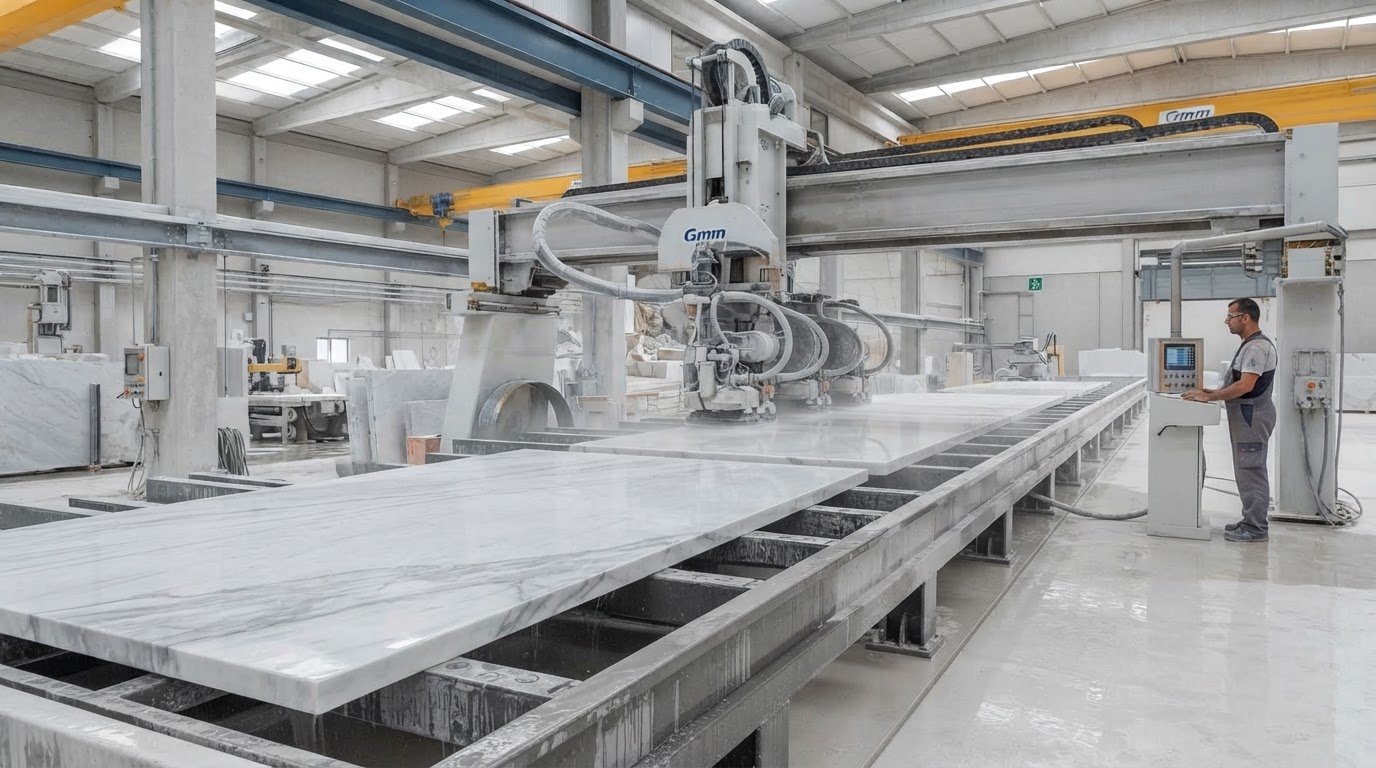
Slab polishing is the stage that turns a rough cut slab into a finished decorative surface. The slab passes through a polishing line with a series of abrasive heads. These heads gradually refine the surface from coarse grinding to fine polishing. For polished marble, the aim is a smooth, reflective surface that reveals the full color and depth of the stone.
Good polishing requires stable machine pressure, clean water, suitable abrasives, and experienced operators. If polishing is uneven, the slab may show wave marks, scratches, dull areas, or inconsistent gloss. For white marble, cleanliness is also critical because surface contamination can be easy to notice. After polishing, slabs are normally inspected under good lighting to check gloss, clarity, and surface defects.
Matching Finish to Project Requirements
A polished finish is common for luxury walls, countertops, and decorative panels. However, not every project requires high gloss. Some designers prefer honed marble for a soft matte effect. Others choose brushed, leathered, sandblasted, or antique finishes for texture and slip resistance. The best finish depends on application, maintenance requirements, lighting, and design style.
Step 5: Surface Finishing Options
Surface finishing gives marble slabs their final look and touch. A polished finish is glossy and elegant, ideal for walls, vanity tops, tabletops, and hotel reception backgrounds. A honed finish is smooth but matte, making it popular for modern interiors, bathrooms, and floors. A brushed or leathered finish has more texture, which can add depth and improve slip resistance. Sandblasted or antique finishes are more common for special decorative effects or areas where a stronger tactile surface is required.
The finish must be chosen before production because it affects appearance, thickness, cost, and delivery time. For example, a honed finish can make colors appear softer, while polishing can make veins look stronger and darker. A textured finish may hide small scratches better than polished marble, but it can also require different cleaning methods. When selecting materials such as custom marble slabs, buyers should confirm finish samples before mass production.
Step 6: Quality Inspection Before Packing
Checking Dimensions and Thickness
Quality inspection is one of the most important stages in the marble slab production process. Inspectors check slab length, width, thickness, flatness, surface finish, color range, vein consistency, crack repair, resin quality, edge condition, and back mesh. For project orders, slabs may also be compared with approved samples or previously confirmed photos. Clear inspection standards help avoid disputes and reduce problems after the container arrives.
Thickness tolerance is especially important for flooring and wall installation. If slabs are inconsistent, installers may need extra leveling work, and the final surface may not be even. For countertops and custom fabrication, accurate thickness also affects edge profiles, sink cutouts, and structural support. A professional supplier should be able to explain its inspection process and provide photos when requested.
Reviewing Color Matching and Defects
Color matching is another critical inspection point. Natural marble is not artificial, so some variation is normal. However, slabs used in the same area should be reasonably coordinated. Inspectors may separate slabs into different bundles according to tone and veining. Visible cracks, open holes, heavy stains, broken corners, and poor repairs should be identified before packing. A careful inspection process protects both the buyer and the supplier.
For importers and contractors who want a deeper inspection framework, our natural stone quality inspection checklist provides practical points for checking stone before shipment. You can also compare material selection guidance in our article about choosing a reliable marble supplier.

Step 7: Export Packing and Container Loading
Export packing is the final protection stage before the marble slabs leave the factory. Finished slabs are usually packed in strong wooden bundles or A-frame structures, with plastic film, foam, rubber pads, or other protective materials between surfaces. The purpose is to prevent scratches, movement, corner damage, and breakage during loading, sea transport, unloading, and inland delivery.
Good packing requires more than simply placing slabs into crates. The factory must consider slab size, thickness, weight distribution, container balance, forklift handling, and destination requirements. Bundles should be labeled clearly with order number, material name, slab quantity, dimensions, and destination information. Photos of packing and container loading are useful records for both sides.
For international buyers, packing quality directly affects profit. A small saving on weak packing can create a much larger loss if slabs break during transport. Professional suppliers understand export conditions and prepare slabs for long-distance shipping. This is one reason buyers should evaluate factory experience, not only material price.
How Factory Capability Affects Finished Marble Slabs
Factory capability can be seen in many details: equipment condition, cutting accuracy, slab organization, polishing consistency, repair technique, inspection records, and packing discipline. A reliable factory does not depend only on one skilled worker. It uses repeatable procedures, trained teams, and clear communication. This is especially important for large construction projects where delivery time, color matching, and documentation must be controlled.
Strong production capability also supports customization. Some buyers need cut-to-size marble tiles, stair treads, risers, countertops, wall panels, bookmatched slabs, or special surface finishes. These orders require drawings, measurements, numbering, packaging labels, and strict checking before shipment. If the factory workflow is organized, custom production becomes much more reliable.
Useful Buyer Tips Before Placing an Order
Before ordering marble slabs, buyers should confirm the material name, quarry origin when relevant, slab size range, thickness, finish, quantity, packing method, and inspection requirements. For natural stone, photos of actual slabs are much more useful than only catalog images. If the project needs a continuous wall effect, ask for slab sequence photos or a dry layout. If the project involves countertops, confirm whether the slab size can support the design with minimal joints.
It is also helpful to discuss acceptable variation in advance. Marble is a natural material, so color and vein differences are part of its value. However, project areas should still be coordinated. A supplier with strong factory control can help sort slabs and provide realistic recommendations. For general natural stone education and industry resources, the Natural Stone Institute is a useful non-competitive reference. For basic background on dimension stone, readers can also review this dimension stone overview.
Conclusion: A Reliable Process Creates Reliable Marble Slabs
The marble slab production process is a complete chain from quarry to finished product. Quarry block selection determines the potential beauty and stability of the material. Block cutting affects slab yield and thickness accuracy. Resin treatment and polishing influence surface quality and visual depth. Surface finishing creates the final design character. Quality inspection protects the project from avoidable defects. Export packing ensures that the finished slabs arrive safely.
For buyers, this process is more than technical background. It is a practical way to judge whether a supplier can support real projects. Hangmao Stone provides marble slabs, cut-to-size production, quality checking, and export support for commercial and residential stone projects. If you are sourcing marble slabs for a hotel, villa, apartment, or public building, understanding the production process will help you choose the right material and the right factory partner. You may also explore our related guide to popular white marble types for luxury interior design.

